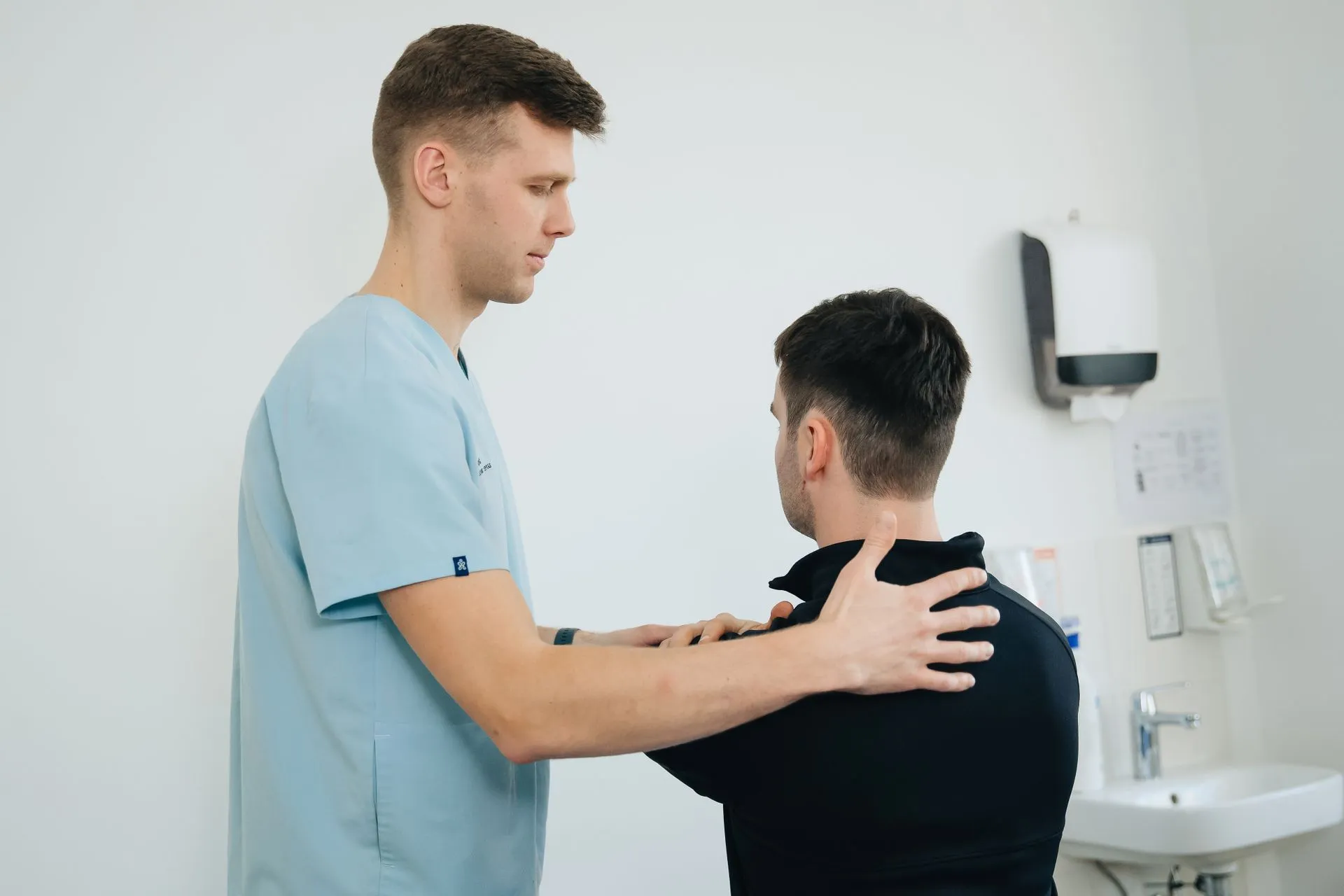
Rest is usually the right instinct after an injury. With frozen shoulder syndrome, it's often exactly the wrong one — the less a stiffening shoulder moves, the faster it tends to stiffen further, and a lot of the Fitchburg patients we see don't realize that until months in.
What's Actually Happening in the Joint
Frozen shoulder, medically known as adhesive capsulitis, starts in the capsule of connective tissue surrounding the shoulder joint. For reasons that aren't fully understood, that capsule thickens and tightens, and adhesions can form that further restrict how far the joint can move. The result is a shoulder that resists reaching overhead, behind the back, or across the body — tasks as ordinary as fastening a bra or reaching for a top shelf become genuinely difficult.
The Three Stages, and Why Timing Matters
Frozen shoulder typically moves through three distinct phases. In the freezing stage, pain increases and range of motion starts narrowing, usually over two to nine months. In the frozen stage, pain may actually ease while stiffness becomes the dominant problem, often lasting four to twelve months. Finally, the thawing stage brings gradual improvement in mobility, which can take anywhere from five months to two years on its own. Left untreated, the full arc can stretch well past a year — sometimes several.
That timeline matters because what helps changes stage to stage. Early on, the priority is managing pain without letting the shoulder guard itself into complete stillness. Later, once the acute pain has faded, the priority shifts almost entirely to reclaiming the range of motion that's been lost.
Frozen shoulder often starts after something that has nothing to do with the shoulder joint itself — a period of immobilization following surgery or a fracture, a minor rotator cuff strain that gets guarded rather than gently moved, or sometimes no clear trigger at all. What tends to distinguish it from a simple rotator cuff injury is the pattern of restriction: with frozen shoulder, both active movement and someone else moving the arm for you are limited, whereas a rotator cuff problem usually still allows a fuller passive range even when active lifting hurts. That distinction matters for figuring out the right treatment approach from the start.
Where Chiropractic Care Fits
Chiropractic care during frozen shoulder isn't about forcing a stuck joint through its full range — that approach tends to backfire. It's about addressing the surrounding structures: reducing muscle guarding and tension that build up around a painful shoulder, correcting the postural compensations that develop when someone unconsciously stops using an arm normally, and working within whatever range is currently available to keep it from narrowing further.
Many patients who start care during the freezing stage report their pain easing sooner than they expected, though it's worth being honest that frozen shoulder tends to run its own course regardless of treatment. The real value of care during this window is usually preserving as much mobility as possible while the underlying process resolves, rather than shortening the timeline itself.
What Helps Between Visits
Consistency matters more than intensity here. Short, frequent sessions of gentle range-of-motion work — a few minutes, several times a day — tend to outperform occasional long stretching sessions, especially once you're in the thawing stage and actively trying to regain lost motion. Heat before stretching and attention to sleep positions that don't compress the shoulder both make the daily grind of recovery more tolerable. Sleeping on the affected side is usually the first thing to change — a pillow tucked under that arm to keep it slightly supported and away from full compression tends to make nights noticeably less disruptive during the freezing stage.
We see a fair number of frozen shoulder cases, often in patients who assumed the stiffness would work itself out and waited longer than they needed to. If a shoulder has been getting harder to move for more than a few weeks, don't wait to see if it resolves on its own. Come in and we'll figure out which stage you're in and what actually makes sense to do about it.
About the Author
Dr. Madison Reiber, DC
Licensed chiropractor serving Fitchburg and Madison, WI. Specializing in ProAdjuster360, Flexion/Distraction, and Graston Myofascial Release.
Book an Appointment