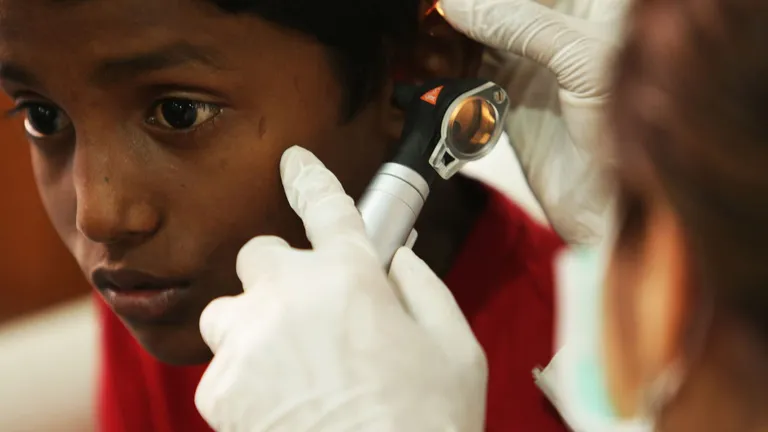
It's two in the morning and your toddler won't stop crying, tugging insistently at one ear and refusing to lie flat in the crib. If you've been through this before, you already suspect an ear infection — one of the most common reasons families end up in a pediatrician's waiting room, and one of the most common reasons parents end up bleary-eyed at 3 a.m. Ear infections aren't one single condition, though. There are three distinct kinds, and knowing which one you're dealing with changes both the urgency and the treatment.
Three Kinds of Ear Infections
The most familiar is a middle ear infection, the kind that sends kids to urgent care with fever and sharp, throbbing pain. It happens when fluid gets trapped behind the eardrum and becomes a breeding ground for bacteria. Children are especially prone to this one because their Eustachian tubes — the small channels that drain the middle ear into the throat — are shorter and sit more horizontally than an adult's, so fluid has a harder time draining on its own. Watch for ear pain that's often severe, a fever, trouble hearing, and sometimes fluid leaking from the ear canal.
Swimmer's ear is a different animal. It affects the outer ear canal rather than the middle ear, usually after water gets trapped inside and creates a damp environment where bacteria thrive. It shows up as pain and tenderness at the opening of the ear, redness and swelling, itching deep in the canal, and sometimes discharge.
Inner ear infections are the least common of the three, but the ones worth taking most seriously. Because the inner ear also controls balance, an infection there can cause dizziness and vertigo alongside the pain, and in rare cases lead to hearing loss or more serious complications. If your child — or you — is stumbling, nauseated, or complaining that the room is spinning along with ear pain, that's worth same-day medical attention.
Middle ear infections, the most common of the three, don't always need antibiotics right away. Many pediatricians now recommend a 48 to 72-hour period of watchful waiting for kids over two with mild symptoms, since a good number of infections start clearing on their own. Pain relief and close monitoring during that window matter just as much as any prescription would.
Where Chiropractic Care Fits In
Back to that 2 a.m. scene: once the fever breaks and any antibiotics do their job, a lot of parents start asking what else they can do, especially for kids who seem to get ear infection after ear infection every winter. This is where chiropractic care tends to enter the conversation, not as a replacement for pediatric medicine but as a complement to it.
The reasoning is fairly simple. Misalignments in the upper cervical spine can affect the muscles and nerves involved in Eustachian tube function, and some families find that gentle adjustments seem to support better drainage and fewer repeat infections over time. That's not a guarantee, and it shouldn't delay a pediatrician's evaluation of an active infection — but as an add-on approach, it's low-risk and, for most kids, genuinely comfortable.
In practice, that means gentle pediatric-specific techniques rather than anything resembling an adult adjustment, paired with general support for the child's immune system and, when appropriate, guidance on natural approaches to reducing inflammation while the body heals. A typical course involves a handful of visits spaced closely together at first, tapering off as drainage and comfort improve.
Building In Some Prevention
For kids who cycle through infections every cold-and-flu season, prevention becomes the real goal. Keeping ears dry after baths and swim lessons, limiting exposure to secondhand smoke, and staying current on regular check-ups — rather than only showing up mid-crisis — tend to make the biggest difference for the families we see. Breastfeeding, when it's an option, is also linked to lower rates of ear infections in infants, likely thanks to immune factors passed along through breast milk.
That 2 a.m. wake-up call is rarely fun for anyone in the house. But understanding which type of infection you're facing, and knowing that medical care and complementary care can work side by side, makes the next one a lot less frightening to handle. Families around Fitchburg and Madison dealing with recurring ear infections are welcome to bring their questions to our team at Revive Chiropractic — sometimes a second set of eyes on your child's history is enough to catch a pattern you hadn't noticed on your own.
About the Author
Dr. Madison Reiber, DC
Licensed chiropractor serving Fitchburg and Madison, WI. Specializing in ProAdjuster360, Flexion/Distraction, and Graston Myofascial Release.
Book an Appointment