
When was the last time you actually noticed your own posture — not in a mirror, but in the moment, mid-scroll or mid-email? Most of us go hours without a single thought about how we're sitting, and that's exactly the problem. Somewhere between the desk job, the phone, and the couch at the end of the day, slouching, rounded shoulders, and a head that juts forward have become the default posture for a huge share of adults, and the effects go well past how it looks.
What Poor Posture Actually Costs You
The average adult sits more than seven hours a day, and every inch the head drifts forward from a neutral position adds meaningful extra load to the muscles holding it up — which is a big part of why tension headaches and neck pain are so tightly linked to hours at a screen. But the fallout isn't confined to the neck and back. A collapsed, rounded chest compresses lung capacity, making full, easy breaths harder to come by. A compressed abdomen can interfere with digestion. Muscles that are constantly compensating for poor alignment tire out faster, which shows up as the kind of fatigue that a good night's sleep doesn't quite fix. Some research even points to a connection between posture and mood, with slouched positions linked to lower energy and a flatter emotional state compared to upright ones. None of these symptoms tend to show up in isolation, either — forward head posture and tension headaches commonly go together, even if the connection isn't always obvious.
Three patterns show up again and again in the Fitchburg patients we see. Forward head posture, often called tech neck, happens when the head creeps forward of the shoulders, putting outsized strain on the neck and upper back for every inch it moves. Rounded shoulders develop from hours hunched toward a screen, tightening the chest muscles while the upper back muscles that should be holding the shoulders back grow weak from disuse. And anterior pelvic tilt, where the pelvis tips forward and exaggerates the curve of the lower back, quietly builds a foundation for chronic low back pain.
How Adjustment and Retraining Work Together
Correcting posture isn't just about telling someone to sit up straighter — the muscles and joints usually need to actually be capable of holding that position first. Spinal adjustments address the misalignments that have built up around the shoulders, mid-back, and neck, restoring the range of motion that poor posture gradually steals. Alongside that, we work on the muscle imbalance driving the posture in the first place: strengthening the weak upper back and core muscles that should be holding you upright, while releasing the tight chest and hip flexor muscles pulling you out of alignment.
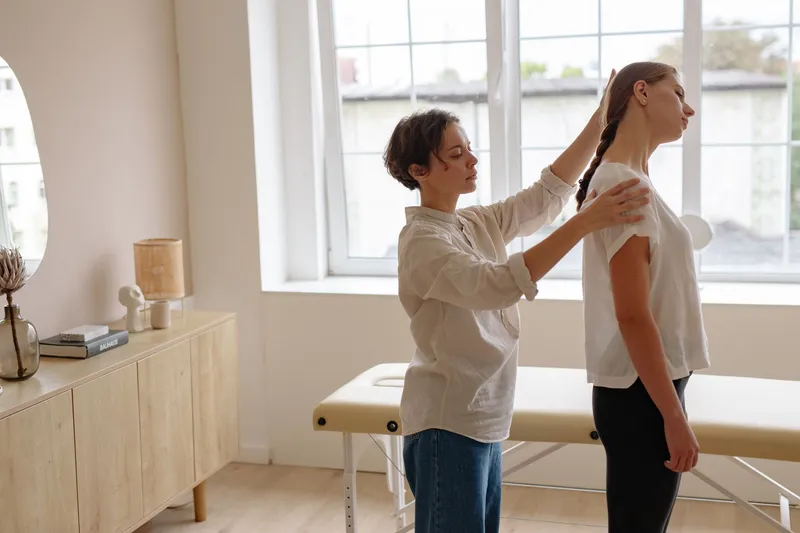
We also look at the workspace itself, since no amount of muscle work holds up against a chair and monitor set up wrong. Getting the monitor to eye level, the keyboard at elbow height, feet flat on the floor, and a chair that actually supports the lower back removes a lot of the daily strain before it starts.
None of this reverses years of habit overnight, but consistent adjustment paired with a workspace that actually supports you tends to move the needle faster than willpower alone ever does. If slouching has become your body's default setting, book a visit at Revive Chiropractic and let's take a real look at what's driving it.
About the Author
Dr. Madison Reiber, DC
Licensed chiropractor serving Fitchburg and Madison, WI. Specializing in ProAdjuster360, Flexion/Distraction, and Graston Myofascial Release.
Book an Appointment